


The Ghost of the Grasslands
How one conservationist’s obsession with a vanishing bustard
became Nepal’s most urgent race against extinction
Based on the Bengal Florican Project · Aditya Pal · Published in Oryx — The International Journal of Conservation
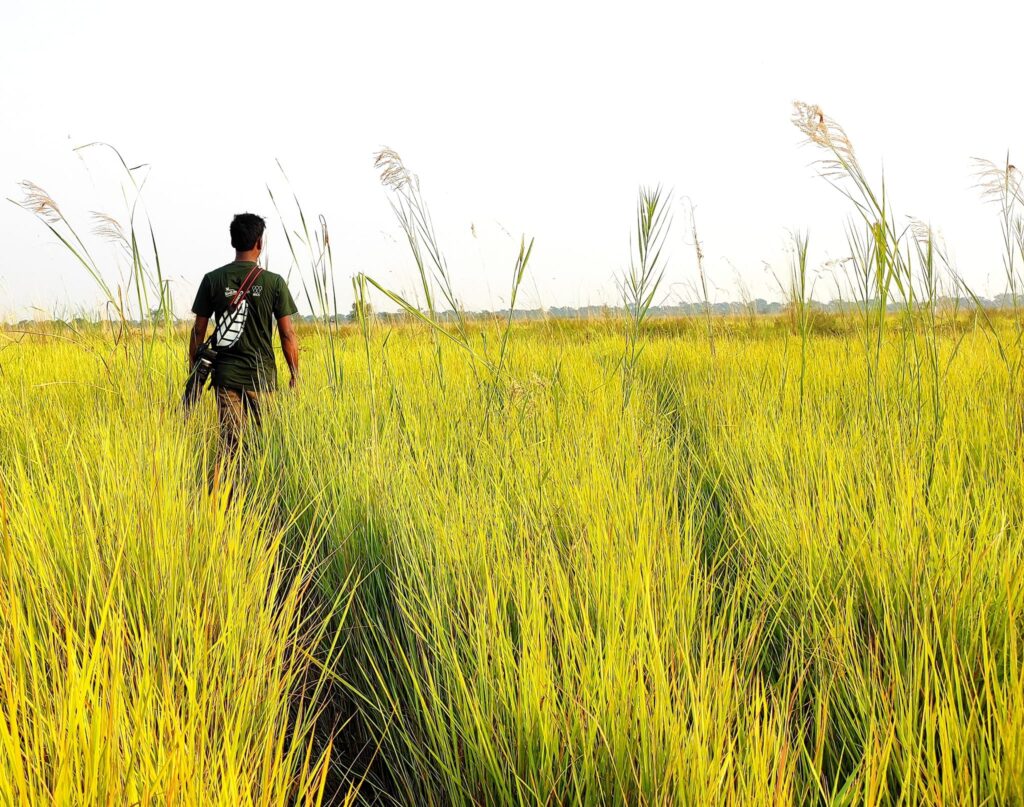
Somewhere in the tall grasslands flanking Nepal’s Koshi River, a bird crouches low and disappears. Its body presses against the earth, neck stretched flat, feathers merging with the dry, sun-bleached stalks around it. Unless you know exactly where to look — and even then — you will not see it. This is the Bengal florican, and it may be the rarest bustard on Earth.
It was 2018 when conservation biologist Aditya Pal first encountered one. He was conducting fieldwork in Koshi Tappu Wildlife Reserve for his master’s thesis when a striking male materialized from the grassland and moved, unhurried, through the landscape. That single sighting set the course of his professional life.
Years later, Pal leads the Bengal Florican Project (BFP), a transboundary conservation initiative spanning Nepal, India, and Cambodia, and serves as Director of the Nature Conservation and Research Committee (NCRC). What began as a graduate student’s field encounter has grown into one of South Asia’s most focused grassland bird conservation efforts.
Endangered
A Bird on the Brink
The Bengal florican (Houbaropsis bengalensis) is the sole member of its genus — a large, ground-dwelling bustard of open tall grasslands. Males are unmistakable during the breeding season: a black head and neck, shimmering white wings, and an elaborate topknot of display plumes. Females are altogether more cryptic, cloaked in buff-brown with dark streaks that render them nearly invisible in their grassland home.
The IUCN lists the Bengal florican as Critically Endangered. Its global population — estimated at fewer than 1,000 mature individuals — has declined sharply over recent decades. The Bangladeshi population is now believed to be extinct. What was once a bird of broad distribution across the Indian subcontinent now survives only in isolated protected pockets.
“This species, a symbol of Nepal’s vanishing grasslands, deserves our collective effort.”
Aditya Pal · Bengal Florican Project
Into the Koshi Floodplains
When Pal received funding from the Conservation Leadership Programme (CLP) in 2022, he described it as a turning point — providing a platform for his first independent conservation project, alongside training in conservation management, fundraising, and scientific communication. His target site was Koshi Tappu Wildlife Reserve, Nepal’s first Ramsar-designated wetland.
The early surveys were humbling. Despite exhaustive searches across potential florican habitat, the team failed to record a single individual. As the breeding season approached, they intensified their efforts. Their persistence paid off: 20 individuals were recorded — 14 males and six females — scattered across the Koshi floodplains.
Surveys involved four-wheel drives, wooden boats across the Koshi River, and long stretches on foot through scorching heat. At one point the team found itself surrounded by a herd of wild water buffalo — a stark reminder, Pal noted, of the unpredictable nature of conservation fieldwork.
Witnessing the birds’ extraordinary camouflage was one of the most striking aspects of the work. When threatened, both sexes flatten themselves against the ground, neck extended, and simply vanish from sight. It is an extraordinary adaptation — and a sobering reminder of how much remains unknown about a species so rarely studied.
What Is Eating the Grasslands
The Bengal florican’s decline is inseparable from the fate of South Asia’s native grasslands — an ecosystem chronically overlooked in conservation priorities. The bird is what ecologists call a grassland obligate: it cannot survive without the tall, open grassland habitats that have been disappearing for decades.
Conversion of native grassland to farmland and settlements has fragmented the species’ range across the subcontinent.
Permitted thatching grass collection and controlled burning within Koshi Tappu alters the habitat structure floricans depend on.
Intensive grazing within and around reserves degrades the tall-grass structure essential for breeding and shelter.
Non-breeding birds move into unprotected paddy fields where they face hunting, disturbance, and pesticide exposure.
⚠️ Perhaps most alarming: despite years of intensive surveys across Koshi Tappu, Pal’s team has never found a Bengal florican nest. Long-time local nature guides report the same. The species’ breeding ecology in Nepal remains almost entirely a mystery.
People as the Solution
One of the more counterintuitive findings of Pal’s fieldwork was how many community members living alongside the reserve had never heard of the florican. Grassland birds lack the charismatic visibility of tigers or elephants and rarely attract the conservation attention their status demands.
The Bengal Florican Project responded with a targeted education campaign, documented in Oryx — The International Journal of Conservation. Key activities included:
Community Workshops
Held in buffer zone communities around Koshi Tappu to raise awareness about the florican and its habitat.
Local-language Materials
Posters, booklets, and audiovisuals produced in local languages for broad community reach.
Student Bio-monitors
School students trained to conduct birdwatching and habitat monitoring within their own communities.
Livelihood Conversations
Direct dialogue with fishers, farmers, and elephant riders to understand economic pressures on shared habitats.
Sustainable conservation, the project concluded, cannot be imposed from outside. It must be woven into the economic and cultural fabric of the communities who live alongside these birds.
The Bengal Florican Project:
Four Pillars
Habitat Protection
Identifying and securing key grassland areas, promoting sustainable land-use practices to arrest ongoing degradation.
Research & Monitoring
Continuous data collection on population trends, behaviour, and threats — building evidence for adaptive strategies.
Community Engagement
Involving local populations in habitat protection through education, participation, and building lasting conservation capacity.
Policy Advocacy
Working with governments and international bodies to secure legal protections and integrate the florican into global frameworks.
The Debate Over Captive Breeding
In 2024, Nepal’s government released a plan proposing captive breeding of the Bengal florican in zoos and aviaries. The proposal drew sharp debate. Pal’s own observations underscore the challenge: nests have never been documented in Nepal, making egg collection for captive rearing essentially impossible under current field conditions.
The debate highlights a fundamental tension in conservation: whether to invest in ex-situ measures for relatively quick population boosts, or to focus on the harder, slower work of securing and restoring the wild habitats without which any reintroduced birds will face the same fate as those they replace.
A Symbol Worth Saving
The Bengal florican will not save itself. It is too rare, too secretive, and too poorly understood. It inhabits an ecosystem that most development frameworks do not even recognise as valuable. It breeds in ways that remain almost entirely unobserved by science.
What it has, increasingly, is people like Aditya Pal — conservationists who cross rivers on wooden boats in scorching heat, who train schoolchildren as monitors, who publish their findings in peer-reviewed journals and take those same findings back to village workshops. Who look for twenty birds across an entire reserve and, when they find them, feel the full weight of what their presence means.
“Through continued research, habitat restoration and community-driven conservation, we can secure the future of the Bengal florican.”
Aditya Pal · Bengal Florican Project
Nepal’s grasslands are vanishing. The Bengal florican is a measure of how much has already been lost — and a reason, if a tenuous one, for hope about what can still be saved.
Aditya Pal holds a master’s degree in Zoology from Tribhuvan University, Nepal. He founded the Bengal Florican Project, The Ornithology, and Wild Chapter, and serves as Director of the Nature Conservation and Research Committee (NCRC). His research has been published in Oryx — The International Journal of Conservation. He hosts Birders of Nepal, a podcast celebrating Nepal’s birdwatchers and conservationists.
Sources: Bengal Florican Project (bengalflorican.org) · Oryx — The International Journal of Conservation · Conservation Leadership Programme · IUCN Red List